
by Emily Clough
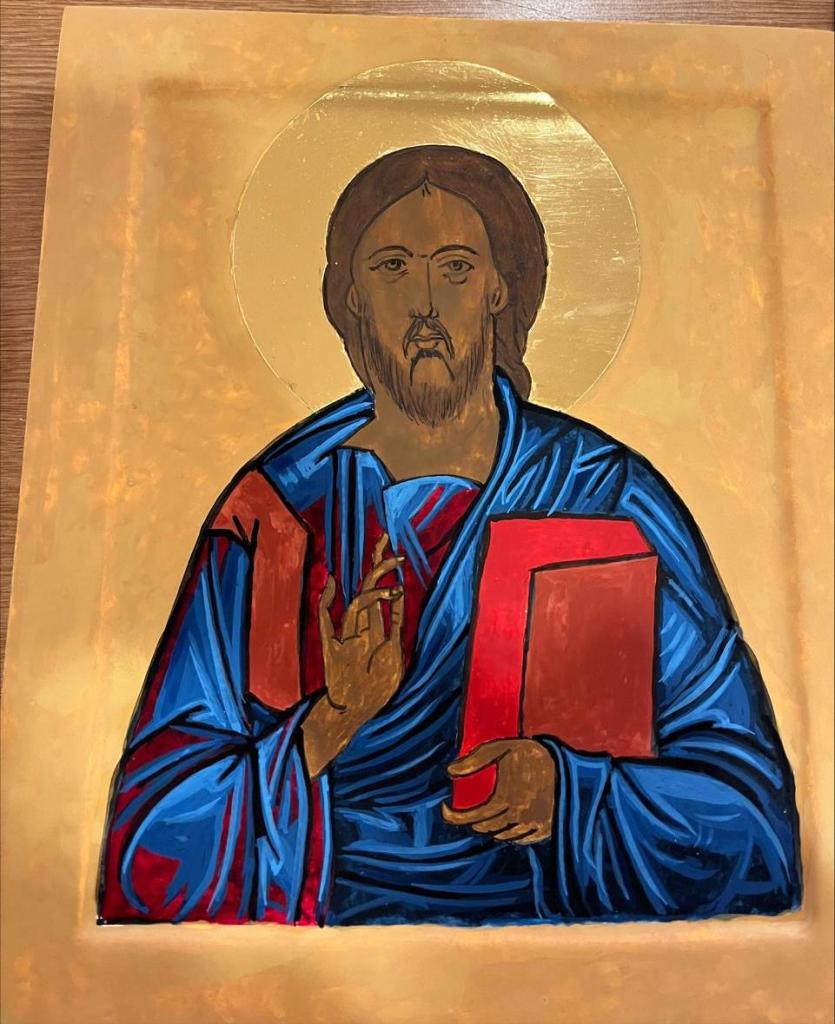
Recently I went on a retreat to learn how to write an icon. My Dad thought I had made a mistake when I told him that’s what I was doing. Surely a person paints an icon or creates one, but a person wouldn’t write an icon. That is however the correct term. I like the idea that when you are writing an icon, you are writing in the language of heaven.
Writing an icon is a process which has many steps. It involves a large amount of self-reflection and a lot of waiting. Everything has meaning. As I created the icon, I learned about the spiritual significance of each stage but also found a lot of personal meaning along the way.
Patience has never been one of my greatest strengths. But sitting staring into the eyes of my Jesus, waiting for another layer of clay to dry, really made me think about my own relationship to God. There has been no other time in my life when I have spent 7 hours a day looking into the eyes of Christ and trying to understand him.
Around the table there were other people doing the same thing as me, and each version of Jesus looked a little different. I spent many hours examining why I thought my Jesus looked rather melancholy. Other people’s looked stern and some looked content.
There was an intangible way in which that face helped me to understand the humanity of Jesus, and therefore grasp a sense of the dual nature of Christ. It has always been a challenge for me to grasp how Jesus could be human, but then I painted in the tear-ducts on my representation, and all of a sudden it just felt real. The summary of humanity in two tear-ducts. A sense of realness.
One of the early, nerve-wracking stages was creating the halo. The halo is first made in layers of red clay. Each layer of clay is painted on, then left to dry. Then the clay is sanded down. On top of the clay, you then gild in gold. You gild three times to represent the trinity. The first layer is attached with watered down glue, the second layer is gilded on using water, and the third layer is attached using the iconographer’s own breath. This process feels both immensely spiritual, and makes you feel as if the icon is coming to life. For the person creating it, this creates a deep personal attachment.
There was also a reflection of myself in my icon in more than one way. Once the halo was gilded, I could see myself literally as a reflection, and the expression on Jesus’ face in many ways reflected my own. I could see my own frustration at the drying time and my fear of making a mistake. Apparently when gilding you can’t really be nervous or hesitate. Any amount of fear can destroy the gold leaf. Breathing on it too heavily or hesitating can lead to disaster.
Against my nature, I developed a confidence which was not fully my own, and I accepted that it was never going to be perfect. It turns out that writing an icon is very forgiving and any mistake can be corrected, given a bit of time. A lesson much easier to learn in art than in life.
The focus on reflections made me think of a quote from Ernesto Cardenal: “We are mirrors of God created to reflect him. Even when the water isn’t calm it reflects the sky”. It is a beautiful idea that we reflect God even when we are not calm. But I like to think that we can reflect God better when we are calm.
When I look at my reflection and calmness it makes me think about living in the moment. Nobody can see the future and it is unhelpful to dwell in the past. Dwelling on the present is just right for us.
The sacrament of the present moment is an idea that some Christians use to express the conviction that God is present at every moment of their lives. In a way it’s a form of mindfulness. It has been said by psychologists that when we live outside the moment, we can rob ourselves of time. It’s that classic idea that if we spend all our time worrying about Monday morning, how can we enjoy the weekend? This reminds me of the verse from Matthew’s Gospel:
“So do not worry about tomorrow, for tomorrow will bring worries of its own. Today’s trouble is enough for today”. Matthew 6:24
Not worrying about tomorrow and living in the moment is a thing that is easier said than done. I’ve realised that I am not the best at living in the moment, but I find it easier to live in the moment when I paint. There is something about being able to focus on one detail of life at a time. Each shape and each colour individually. Each colour unique and beautiful and made by God. Painting things allows me to focus on them without any level of distraction. I can look at a shade of green and focus on it. I can try to match it. Then I can think about how it differs from the shade of green beside it. When I keep doing this, I think about how the shades and colours fit together and I see them form a picture. A part of me wonders that when you see everything outside as a picture, one colour at a time, even the worst of weather has a sort of beauty. It’s just a different arrangement of things.
When painting, I find it quiets my mind in a way not much else can, and that gives me space to pray.
I often wonder how rich my life could be if I could see the everything in the world with the care I do when I paint, if I could focus on the ideas in a conversation like the colours of individual leaves in a tree. The patience I could have if I wasn’t worried about the next thing I have to do! The ideas that could grow if I wasn’t always chasing the next thought! Maybe I’d be consistently late and distracted, but I might just be able to find something truly beautiful.
An icon is a reassembling of the elements of the creation and offering them back to God their creator. In an icon everything that exists is contained in the natural elements of clay and egg and gold. There is a sense of reciprocal love in creating an icon. Everything given is offered back. Even the part of ourselves, the breath and the time and the creativity, we put into it.

 Young Anglican Theology
Leave a comment