
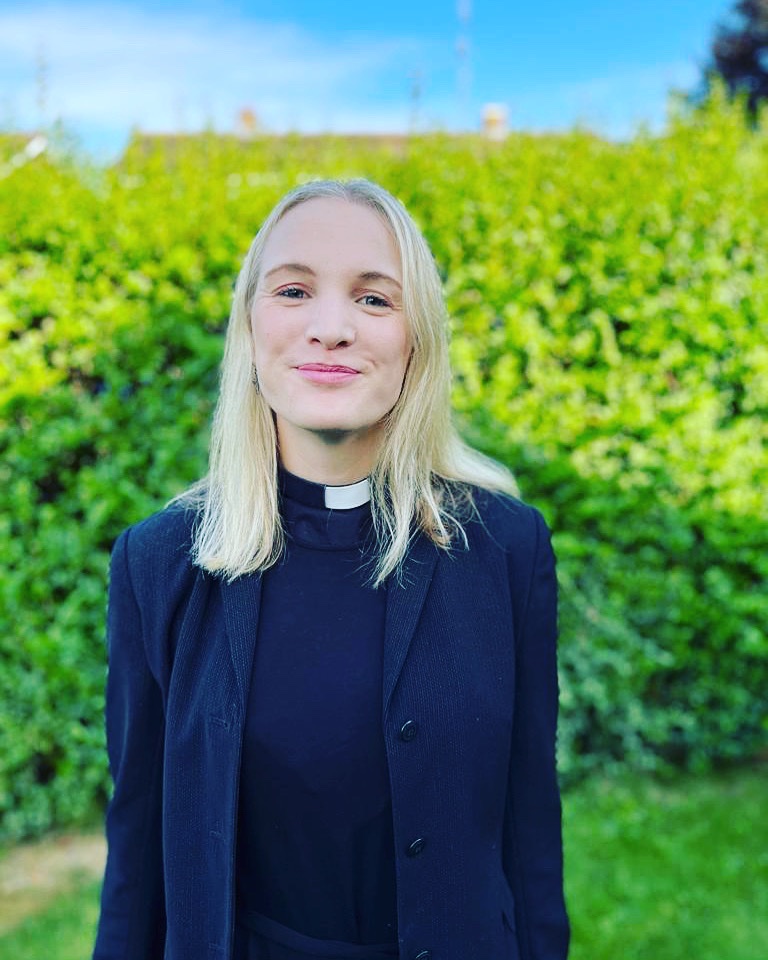
by Sorrel Shamel-Wood
My Journey
On Saturday, my son celebrated his first birthday. On Monday, my maternity leave ended and I returned to my role as assistant curate in the Dorchester Team Ministry, Diocese of Oxford. A lot has changed in the year of my absence: for a start, there is a new Supreme Governor of the Church of England: His Majesty King Charles III. The Living in Love and Faith consultation period has ended, and a General Synod has met and voted in favour of proposals to allow same sex couples to receive a blessing in church after marriage. Closer to home, across the parishes of our ministry team, there has also been a lot of changes: a new rector has been licensed at Dorchester Abbey; people have been born, and married, and died, and moved into the area, and moved away.
The ministerial context, like Heraclitus’s river, is not the same as the one I left twelve months ago. And equally, I am not the same person I was when I went on maternity leave. During my maternity leave, I was ordained priest and I presided at the Eucharist twice. Which means that, just as I became a new mother I also became a new priest. To what extent can these identities, both deeply vocational, both arrived at after a process of waiting, complications and struggle, be extricated? Are the two identities in conflict? Am I a priest first, or a mother first? Or perhaps, do the dual vocations of motherhood and priesthood, of priesthood and motherhood, complement and inform each other?
Some Background
Of course, there are many in the Church, including in the Church of England, who do not think ordained ministry and motherhood should go together at all. Throughout most of Church history, a priest has been a father: spiritually in the Roman Catholic Church and often biologically as well in Anglican and Orthodox churches. A woman’s vocation was to serve the Church as a nun, or to contribute to the furthering of the kingdom by birthing and raising Christian children, or perhaps other good works such as helping the poor or teaching. Preaching, presiding at the eucharist, conducting a wedding ceremony and other priestly duties were simply not conceived of as women’s work.
In the Church of England, this changed with the ordination of female priests in 1994. At that time, some Anglican provinces including Brazil, Canada, Hong Kong, the USA, New Zealand and the US had already been ordaining women as priests for about twenty years. Some, such as Central Africa, Melanesia, Papau New Guinea, Pakistan and South East Asia, still do not. In my context, being a priest and a mother is not unusual: many of my clergy friends are mothers and so were able to offer advice and support as I began this particular path. In fact, my own mother is a priest so I am part of a sizeable “second generation” of women clergy whose mothers are also ordained. I am not a trailblazer by any means, in either personality or circumstance.
Priesthood and Motherhood
So, do priesthood and motherhood go together? If we consult the ordinal (the Church of England ordination service) we can see that there are many overlapping qualities and responsibilities shared by priests and mothers. We can also make some straightforward analogies. For example, a priest is to “sustain the community of the faithful, by the ministry of word and sacrament”1, just as a mother sustains her child: while nursing, or by preparing meals and packing a seemingly infinite number of snacks for a day trip. A priest must “set the example of the Good Shepherd”, something any Christian parent also aims to do when raising their child. They are to delight in the beauty of the Church and “rejoice in its wellbeing” just as a mother delights in the beauty of her child, and rejoices when the child is flourishing. A priest is a “living sacrifice”, and as all mothers will attest, motherhood at times demands all kinds of sacrifices, beginning with the strain of a body during pregnancy and the pain and danger of childbirth. A priest is to “declare the wonderful deeds of Him who has called us out of darkness into his marvellous light”, and right from early biblical descriptions of creation we see the use of womb and birthing imagery to describe the bringing about of God’s world.2
There is also a theological school of thought which argues that Mary, the blessed mother of Christ, can be conceived of in priestly terms. For example, she was consecrated by God for a specific purpose, she sacrificed her body to participate in God’s great redemptive plan, and she was overcome by the Holy Spirit when she conceived the Son of God. In his role as great high priest, mediating between God and humanity, it is the humanity rather than divinity of Christ which enables the mediating role of his priesthood, and this can be said to have come from Mary, the theotokos (God-bearer). However, others would argue that while there are priestly aspects to her character and ministry, she was not ordained a clerk in holy orders and was not fully a priest in that sense.3 Also, all Christians form part of a priesthood of royal believers; ordained priests are simply set apart for particular ministry, just as Mary was set apart for a particular task. But all Christians have vocations; priests are no greater or no more deeply called than any other follower of Christ.
Personally, I don’t find the equating of Mary and priesthood very helpful, despite being both a mother and a priest. I have always felt more drawn to Mary Magdalene, apostle to the apostles, as inspiration for my role to preach the good news. Or of Mary of Bethany, sitting at the feet of Jesus, captivated by his teaching. Mary’s motherhood involved the deepest kind of sorrow: a sword pierced her heart, just as Simeon prophesied in Luke 2:35, as she watched her son be tortured and killed. I hope and pray that I never know the depths of Mary’s sorrow. Moreover, for me it is not Mary’s priestly vocation that I think the Church needs to rediscover so much as her humanity: I often find that depictions of Mary are too sanitized and refused to engage with the messy reality of pregnancy and childbirth.
Challenges and Opportunities
Being both a priest and a mother then, does not easily find a precedent in scripture or in Church history. I must look to my contemporaries, and to my own mother and her pioneering generation, for guidance and as role models. Already, as I return from leave, I can see that combining these two important and all-consuming roles will have real practical and emotional challenges. Both priests and mothers face unrealistic expectations, the pressure to be perfect, and both are at serious risk of burnout from exhaustion and emotional demands. The demands placed upon both twenty-first century parents and twenty-first century Church of England incumbents have increased substantially in comparison to the mid twentieth century.4 Whilst on maternity leave, I found it difficult to nurture my spiritual life because of the constant demands of a small infant: in church I found I could not focus on the teaching and liturgy because I was too focused on caring for my son. I have technically returned to ordained ministry part-time, working “three days per week plus Sundays” as the Church of England calls it, or four days per week, as it would be described by anyone else. But a Christian minister is never really part-time, in the sense that things crop up outside of those hours that cannot be ignored. And a parent is always a full-time parent, even when they are working part-time, because they never stop worrying about their child.
However, it is almost certainly the case that these challenges are the same as those many other working, Christian parents are facing. Working parents in the UK are struggling with steep childcare costs and unaffordable housing. Christian working parents may not have time to contribute to the life of their local church as much as they would like. All Christian parents are striving to teach their children to flourish in a fallen world, and to learn what it means to follow Christ just as my husband and I are. As a priest and a mother, I don’t claim any greater sacrifice than that of any other parent. In fact, many other parents face far greater challenges and sacrifices. And as a mother and a priest, I don’t claim any greater spiritual depth than that of other mature, prayerful Christians in my community.
Bean
I wrote the poem “Bean” when I was heavily pregnant, and feeling anxious about the state of the world into which I was bringing my son. If anything, when he was born, the anxiety intensified: it was a difficult, complicated birth and it coincided with a massive storm across the United Kingdom and Russia’s invasion of Ukraine. When I brought my son into the world, I felt fearful but also full of hope and faith. My poem explores this juxtaposition of hope and anxiety which we feel bringing new life into a troubled world, particularly as people of faith. In the poem, I think about receiving the Eucharist while pregnant and how this impacts on the fetus, practically and spiritually. I think about the difference between a traditional, Catholic view of family and contemporary concerns about over-population and the climate emergency. I wrote the poem when I was about to become a mother and soon to become ordained as a priest. But looking back, I see that it could have been the poem of any Christian parent, filled with both anxiety and faith.
Bean
You kick and punch whenever you hear the organ,
little dancer in the warm, wet darkness.
And already you consume the body
of our Lord Jesus Christ:
Little wine and wafer straight through the placenta.
Already you hear the archaic rhythm
of ‘World without end’.
When they say you’re too little to take communion,
too small to fathom metaphysical mysteries,
tell them, ‘I knew Christ in my mother’s womb,
and already I was perfect. A jewel,
knit together in the secret place,
forged in deep love, desired and wanted.’
They say the Church fades from this land
like a great wave receding from the shore,
that memory of the words ‘Our Father’
seeps away forever like a fading mist.
What worlds will you see, speck of stardust?
They say that the oceans are rising,
all kinds of marine life are dying,
that even to conceive of you in this crisis
is an act of gross irresponsibility.
They say that the sun is setting on the West
and we almost certainly deserve it.
And I feel you so close, little wriggle-fish,
swimming freely before anyone has told you
that your dreams are ridiculous,
before any of your tiny bones have been broken
and you haven’t yet learnt how to cry.
And as I wrestle with the isofix car seat,
loafing around while you rise here,
praying for safe passage through primal waters,
I know that anticipating your humanity
Is my greatest act of faith.
- Common Worship Ordination Services | The Church of England ↩︎
- See, for example, Job 38:8. ↩︎
- See, for example Priestly Dimension of Mary : University of Dayton, Ohio (udayton.edu) ↩︎
- This Radio 4 podcast outlines how the demands of parents have changed since the mid 20th century BBC Radio 4 – Thinking Allowed, Parenting ↩︎

 Young Anglican Theology
Leave a reply to June wood Cancel reply