

by Emily-Grace Sainsbury
Celtic spirituality calls places where people might feel a particularly close connection to God ‘thin places.’ It is almost as if, there, whatever boundary separates the secular world from the sacred becomes translucent. Art has the potential to inspire a connection with God through the material in much the same way; the material is not the cause of the connection, that is our identity as God’s creation with whom God wants a relationship, but it can offer us an opportunity, like a bridge over that ‘boundary’, to which we can respond.
When my husband and I were commissioned to make a log shaped tabernacle for the Creation Chapel in the Franciscan Centre at Ladywell Convent, I was struck by the question of how God might want to work in this material opportunity, through us and through the subsequent tabernacle. I was deeply aware of the way each decision we made, be it practical or aesthetic, might contribute or distract from someone’s prayer and contemplation and so my ideas became concerned with the piece’s symbolism, where there might be hidden opportunities to communicate something more about the nature of God.
The project became worship and prayer for me whilst Nathan, sensing this was not his vocation, stepped back. I began to ‘write’ the tabernacle, as I imagine iconographers ‘writes’ icons. (Though Nathan remained on hand to assist when I required his practical experience.)
Many theologians throughout history have used the metaphor of a book to express the way nature reveals God and I hoped the tabernacle, in its design that preserved and exhibited its natural beauty, might continue this revelation. Therefore, though the below commentary reflects my personal spiritual journey through the process and the theological basis I personally considered, it certainly isn’t to propose this as its unequivocal meaning; I pray that the Holy Spirit continues to use it to reveal something new to those who consider it.
The Tabernacle and the Bog-Oak:
Spiritually, I experienced an invitation to participate in the promise of 2 Corinthians 5:17: “So, if anyone is in Christ, there is a new creation: everything old has passed away; see, everything has become new!” The tree was cut, it had ‘passed away,’ but a ‘new creation’ was to be revealed, for this log was to have a new purpose in Christ. Our woodcraft business began because of Nathan’s profession as a tree surgeon, where he saw beautiful pieces of wood merely turned into chip; together we began to repurpose wood he brought home into creations that would instead continue to express the magnificence of God’s creation and the tabernacle would become such an explicit example of this.
I first intended to use a piece of oak, inspired by the Irish bog-oak that the Sisters had purchased for us to install beneath the tabernacle. Bog-wood is an incredible natural phenomenon; though pieces are several thousands of years old they have been naturally preserved by peat bogs, causing the process of fossilisation to begin and meaning the wood is stronger today than it will have ever been.
The ancient, solid bog-oak and the comparatively young, freshly cut oak tabernacle spoke to me of God who is Alpha and Omega, who is experienced in old and familiar tradition and in new, fresh expressions. God who is God yesterday, today and forever.
From Oak…
Although using oak was my intention, it came to light that the size and shape of the pieces of oak I had available weren’t suitable. Therefore, I used the below piece of cedar but felt somewhat disappointed this choice didn’t have the same theological reasoning, neither was cedar seen to be as valuable as oak today, it was purely chosen for its physical properties.
However, I included my reflection on that initial plan as a reminder that there is so much sacred to experience on the way to where we are heading which can be so easily missed or dismissed as ‘irrelevant’ when we are only focused on the end goal. I was reminded of the formation all experiences provide and how we perhaps ought to be more aware of how and why we have become the way we are or have ended up in a particular situation. Though the outside was a cedar log, it is fitting of the symbolism that the shelf inside it was later made from a smaller branch of the same oak tree I had first hoped to use.
…To Cedar:
Only after the tabernacle was finished did I find myself stumbling upon mentions of cedar as a valuable material in scripture. One passage I read was 1 Chronicles 17.
“Now when David settled in his house, David said to the prophet Nathan, “I am living in a house of cedar, but the ark of the covenant of the Lord is under a tent.” Nathan said to David, “Do all that you have in mind, for God is with you.” But that same night the word of the Lord came to Nathan, saying: Go and tell my servant David: Thus says the Lord: You shall not build me a house to live in. For I have not lived in a house since the day I brought out Israel to this very day, but I have lived in a tent and a tabernacle. Wherever I have moved about among all Israel, did I ever speak a word with any of the judges of Israel, whom I commanded to shepherd my people, saying, Why have you not built me a house of cedar?”
I was less encouraged on reading this, for here God tells Nathan and David not to build him a house of cedar… this prompted me to study the passage further, to explore its context so I could interpret it better. The story continues in 1 Kings 6, when it is built by his son Solomon with God’s approval:
”He built twenty cubits of the rear of the house with boards of cedar from the floor to the rafters, and he built this within as an inner sanctuary, as the most holy place. The house, that is, the nave in front of the inner sanctuary, was forty cubits long. The cedar within the house had carvings of gourds and open flowers; all was cedar, no stone was seen.“
My prayer in response was one of thanks for the God-given gift of humour revealed by its context: It was Solomon’s vocation, not David and Nathan’s, and my husband, who as I mentioned had decided it was not his vocation, is in fact ‘Nathan David Sainsbury’.
Combining Design and Function:
The only criteria given by the FCL was for the tabernacle to look like a log and have the image of the earth on it, complementing the images of space adorning the walls that presented the discoveries of science as revelations of God.
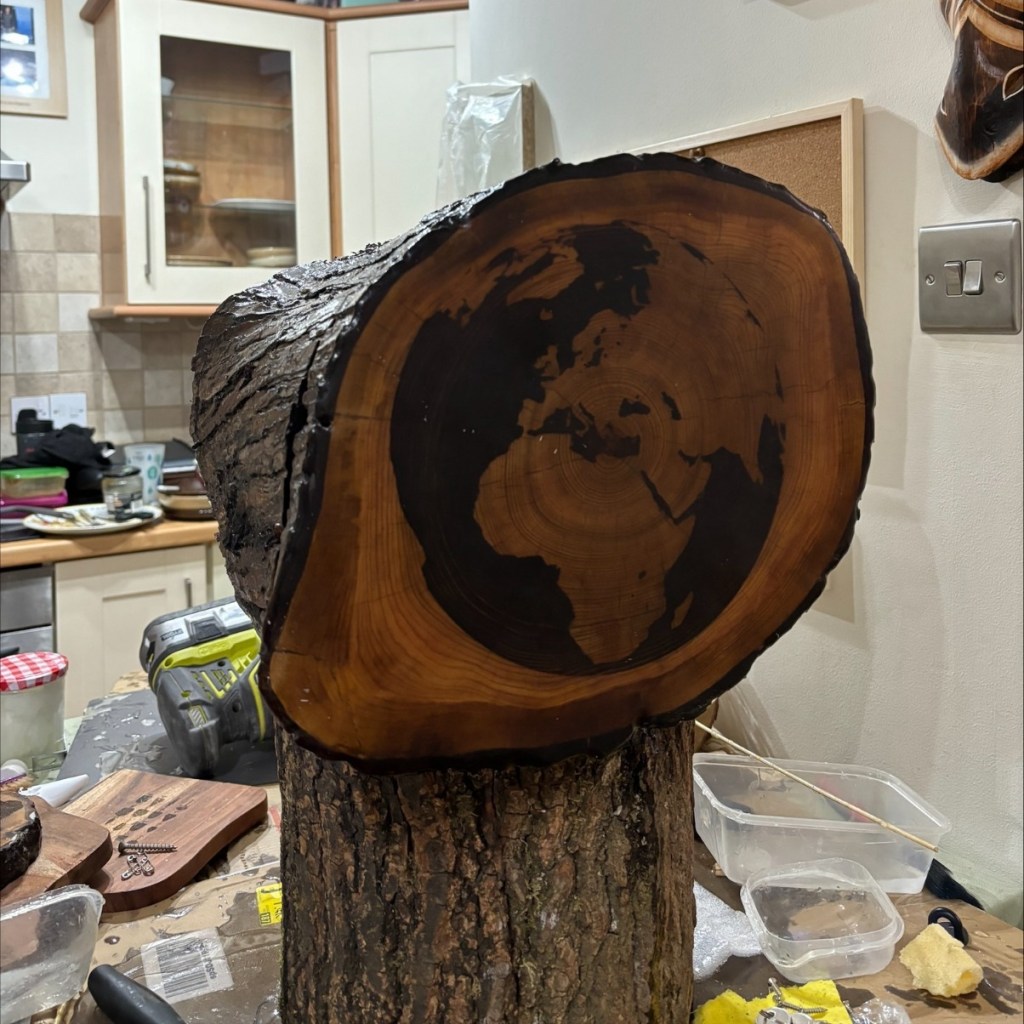
The combination of the earth image and the tabernacle’s function spoke to me of Jesus, Emmanuel (‘God with us’), in the world by way of communion, but also behind the world. “Yet for us there is one God, the Father, from whom are all things and for whom we exist, and one Lord, Jesus Christ, through whom are all things and through whom we exist.“ (1 Corinthians 8:6).
I later designed a matching shelf, to use during Adoration, which was also inspired by this verse as well as by John 1:3-4 and something I had read from Ilia Delio, who specialises in science and religion, about Teilhard De Chardin:
“Teilhard found Christ present in the entire cosmos, from the least particle of matter to the convergent human community. ‘The Incarnation,’ he declared, ‘is a making new . . . of all the universe’s forces and powers.’ Personal divine love is invested organically with all of creation, in the heart of matter, unifying the world.”
The shelf was made from the core of the tabernacle log. It had developed a crack on the right-hand side which I chose to fill with a blood-red resin, a reminder of the sacrifice of Christ as the ultimate expression of God’s unconditional love for us. Creation demonstrates that love as a gift far beyond anything we deserve, one which is given without any ulterior motive, but Jesus, and the offering of the Holy Spirit, demonstrate that is not only ‘we don’t have to do anything ‘deserving’ to receive God’s love’, but in fact ‘God’s love is given despite the things we do.’
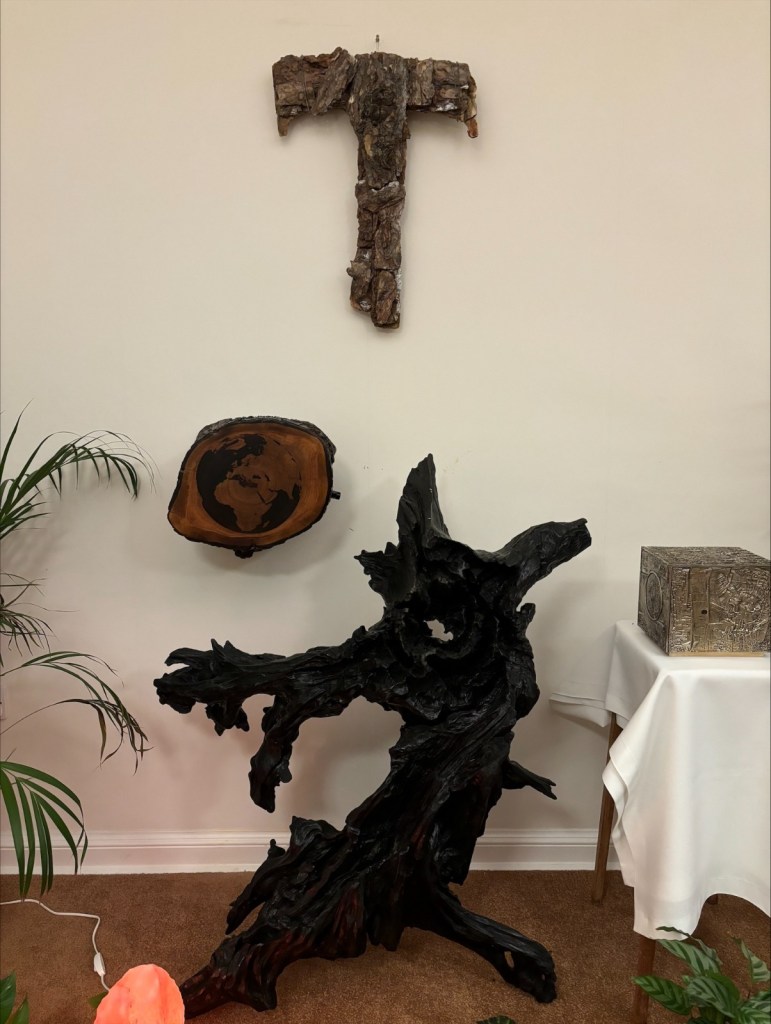
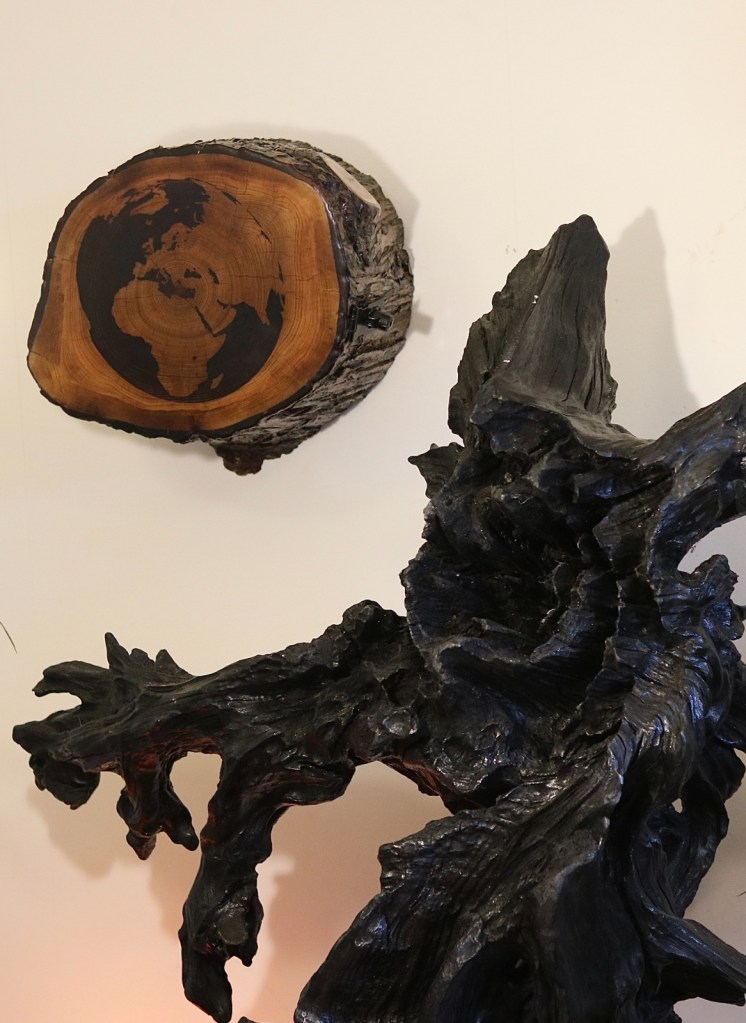
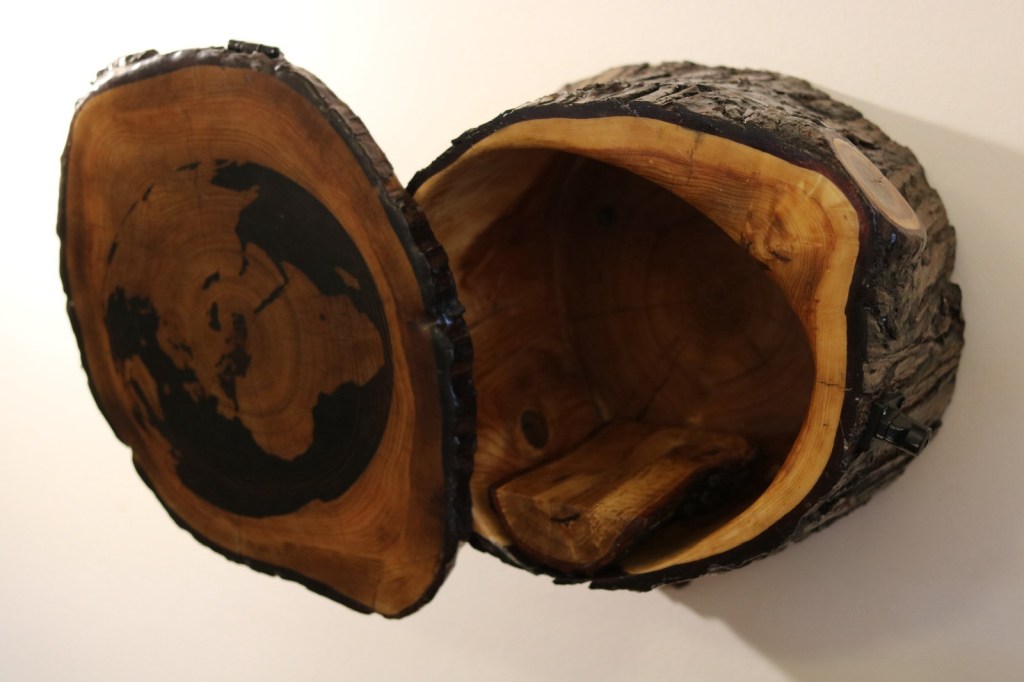
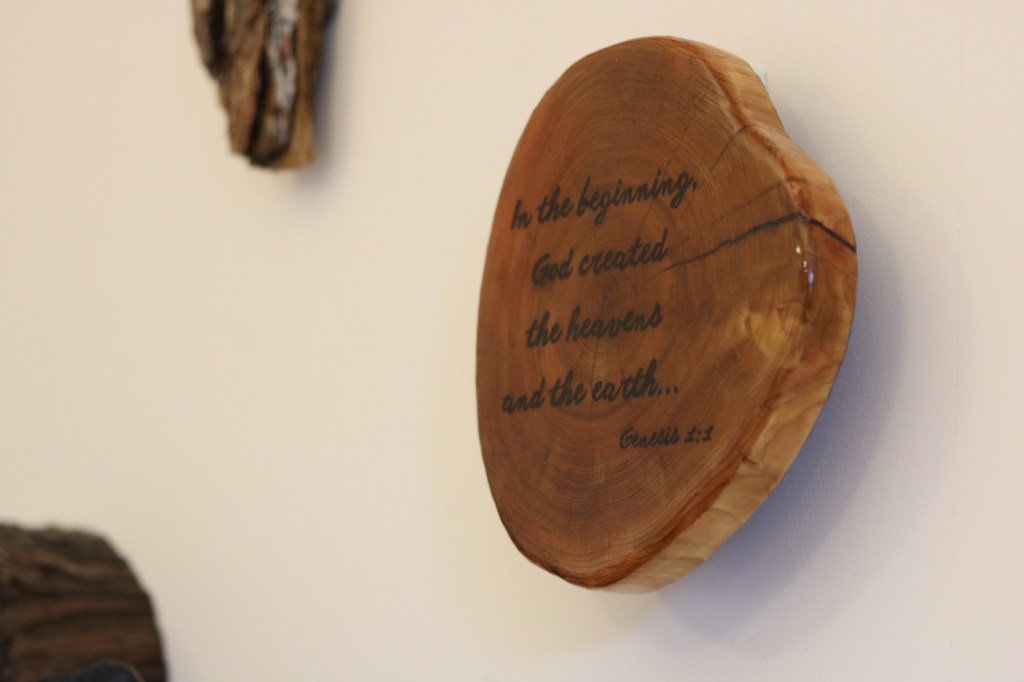
I was compelled to learn how the tabernacle would be used for ‘Adoration’, which is not part of my own spiritual practice; I am beyond grateful for the breadth of tradition in the Anglican Church, that acknowledges how the sacred can be expressed in such a range of modes, understanding the uniqueness of a relationship. It has enabled me to see God in new ways and places which has been essential for me to be able to design something that connects with the diverse range of Christian denominations that the FCL attracts. This inspired the way in which the engraved door turns to open rather than opening outwards, like the tomb stone found rolled away on Easter morning. Opening the door, revealing the presence of Christ, turns the world upside down. “The blind receive their sight, the lame walk, the lepers are cleansed, the deaf hear, the dead are raised, and the poor have good news brought to them.” (Matthew 11:5 NRSV.)
In Acts 17:6-7 it’s written: ‘When they could not find them, they dragged Jason and some believers before the city authorities, shouting, “These people who have been turning the world upside down have come here also, and Jason has entertained them as guests. They are all acting contrary to the decrees of the emperor, saying that there is another king named Jesus.”’ We are called to continue to live like this. As tabernacles ourselves, each a temple of the Holy Spirit, the design is an invitation to each of us, to be open and reveal Christ in our actions living and loving radically, turning the world upside down.
Interview:
 Young Anglican Theology
Leave a comment